The last few months of 2013 were a horrible, terrifying slide into Major Depression. I tried all the tricks, followed my treatment plan, and still nothing. I wasn't eating, I wasn't smiling, I wasn't even able to laugh. It was pretty darn bad. So imagine my surprise when my friend P from church invited me to a dinner party on New Year's Day. He said no one would pressure me and I could hide in a corner if I wanted to, but that we would play games, and I would have fun. So, for the first time in my life, I went to a New Year's party. I was really looking forward to it!
We played a super hilarious game called Braggart (I think that was it, anyway) with cards where we made up stories and then stole the good bits of other people's stories. Everyone was so entertaining, and I had fun. I felt like I hadn't had the chance to even pretend to be happy in so long.
It was a very cold day, thirty below freezing or so, but the condo was toasty from cooking and company. While I was doubtless the boringest, wort guest ever (hello crippling depression), I was happy to be there. It was especially nice to be out of the house and away from my parents on the first day of the new year. New starts and all that.
As a thirty-year-old paying rent, I knew I had every right to go and and do whatever I wanted to do, even if I was still living with my parents. But, in some sort of bizarre quest not to be a total bitch, I did try to be considerate of them. So I told my mother that if I didn't call by the 9:00 train I'd be taking the last one of the night. I'd also arranged with a friend that if something went horribly wrong I could stay at his place. I had this shit under control.
Because I think it's rude to have telephone conversations while you're at a dinner party, I turned my phone off and left it in my bag by the door. To be honest, I also didn't want to risk having everyone find out that my mother still checks up on me - that my own family doesn't think I'm capable of running my own life, that my mother still treats me like a child. Even though I was sick, it's not like I didn't have my shit together on this one.
But I hadn't counted on my mother waking up at 10:00 pm and deciding it was too cold for me to walk home, and single-handedly scrapping my entire plan. She texted me a couple of times, and of course when I didn't answer because my phone was off, she started calling and leaving messages. Not one to be put off by the fact that I was obviously still having fun with my friends, and was an adult fully capable of taking care of myself, my mother put her detective skills to good use and somehow located the phone number of the place I'd gone. She then proceeded to call them and ask for me. The second I heard their phone ringing, I had this cold feeling in the pit of my stomach, and started feeling lightheaded and disconnected, like a deer caught in the headlights. I knew - I just knew - what was happening. And I so wasn't prepared to deal with it.
Once our host figured out that the person on the phone wanted to talk to me, he handed over the phone. It was obvious that he was as taken aback and embarrassed as I was. Since there was nowhere for anyone to go, everyone got to listen to my half of the conversation.
Like talking to a two-year-old, I kept my voice calm and level, speaking clearly and simply. I told my mother that everything was fine, and reminded her that I'd already told her about my plans and there was no need to be calling. But it was no use. My mother was already in a full-throttle fit, yelling at me that I should have answered my phone, and insisting that I had to take the metro home immediately so my father could pick me up in Laval and drive me home - it was absolutely too cold out for me to walk home from the train the way I'd planned. Never mind that I've spent my whole life weathering cold winters, or that I was capable of making my own decisions, or even that being a renter in my parents' home didn't give them the right to control my life. She'd made a decision and wasn't about to be mollified or dissuaded or derailed.
So I gave in. I 'okayed' and 'fined' until I finally got her off the damn phone. Then, of course, I had to explain to my hosts that I was leaving because if I didn't give in to my mother's irrational demands she'd be having a fit for hours - maybe even days - before I'd finally be able to calm her down. That I'd spent my whole life hostage to her moods and didn't know how to stop giving her what she wanted, even though I knew that just made things worse in the long run.
Everyone was incredibly nice about the situation, telling me that it was alright, but for me it absolutely wasn't.
I felt completely humiliated. My mother had embarrassed my in front of everyone by treating me like a child in public. I felt ashamed that people knew that this is my family, this is my life, that I wasn't allowed to be a grown-up. I felt deeply ashamed at having allowed this to happen, at not having kept my phone on because I know how my mother is. As I bundled myself up and left I felt so small, and so hurt, knowing that my mother would do that to me just to make herself feel better, that she'd cost me a chance at friendship and that I'd probably never be invited over again (and, of course, I haven't been).
As I rode the metro, the shame started to fade and be replaced by anger. Rage, even. How could she do this to me? It was completely inappropriate! I felt so, so angry! By the time I got to Laval, this too had faded, and I just felt weary. Weary of the life I was living, of the way people treated me, of being depressed. When I got to the car, my brother was there, too, and it turned out that everyone in my family thought I was wrong and should have had my phone on, and needed to do what my mother said. I felt so betrayed: I felt like no one in my family ever protected me from anyone else in my family, and I was all alone. I wanted to cry.
The next day, I went to work and realized that someone had to make the first step in repairing this mess, since my mother had decided she was still pissed off and not speaking to me. On my way out of the office, I texted her to say that, while I understood her perspective, what she did was unacceptable and I wouldn't tolerate it, and that she was never to do that to me again. She totally flipped out, telling me that I was the wrong one, and everyone knew it, but that I'd find a way to save face with my friends, probably by lying to them and saying that she had a serious mental illness.
I couldn't take it. I just couldn't. It was such a hurtful and personal attack. I saw that she didn't understand how I was feeling at all, and didn't want to. She didn't see that there were boundaries, and I apparently wasn't able to enforce them. I was so unhappy, and so sad, and I didn't want to go on struggling so hard against my pain for nothing, just to be shot down. So I went straight to the store and bought my favorite cutting knife. I hadn't owned a serious knife like this in years, intended only for this, to hurt myself, to open my skin, to cut myself wide, to end my life with precise incisions. I felt like, even in this, I was giving my control over to someone else, and I didn't know how to get it back. I just knew that this was one straw too many - one weight too much - and I couldn't stand against the tide anymore.
When I told a shorter version of this story in my DBT therapy group as an example of an invalidating environment, there was an audible intake of breath and one 'eiiigh' when I got to the part about my mother phoning the party host to make me come home. In the back of my mind I'd always been thinking that I'd overreacted, that the situation wasn't that bad and that, really, I was the one in the wrong; since I'd made a mistake, I deserved to be punished by being humiliated. Sharing this story, I felt for the first time that maybe the way my family treats me, and has treated me, is not okay. It's really not okay. And maybe it's not my fault. And maybe that makes it okay to stand up for myself.
Showing posts with label major depressive episode. Show all posts
Showing posts with label major depressive episode. Show all posts
Wednesday, February 4, 2015

Saturday, December 13, 2014
The Music Man: Prescription Amphetamines and the Worst Date Ever *trigger warning*
In the Fall of 2009 I was beginning my second year in Graduate school (thesis writing year) and my depression was still getting worse. I'd taken one seminar final paper deferral the Fall before, and three in Winter semester -- yes, that would be all of my courses. I didn't get as much research done over the summer as I'd hoped, even though I worked at it every day. I felt like I was sliding, falling, slowly suffocating. Everything was getting a little too difficult, a little too beyond my capability. Although I begged him to let me try ECT, my psychiatrist was unwilling to consider it as as option for me. I was maxed out on Wellbutrin XL and feeling like there was nowhere to go when my psychiatrist and I made the decision to try augmenting it with Ritalin.
On the face of it, Ritalin was actually the best antidepressant I've ever taken, at least for the first few days. I'd had consistent problems with tiredness, low energy levels, and an inability to concentrate, and Ritalin fixed that right away. I was able to focus on my research, to cut through the fog enveloping my brain and put ideas together, to understand what I was reading. I felt alert and awake, and had the energy to walk from one side of campus to the other, to get through my daily activities of worship and study. I took two doses of Ritalin a day, once in the morning and once in early afternoon, and suddenly I was feeling the way I'd felt when Wellbutrin SR had worked: I was feeling like myself. While I didn't really feel any better mood-wise, I could be productive; I felt I had a shot at maybe living my life the way I wanted to, the way that mattered to me. I believed that my mood would stabilize over time back to baseline if I could keep from destroying my life and my goals and my dreams in the meantime by being able to string words together into sentences.
The Ritalin crash was brutal, though, and ultimately an unmitigated disaster. For some reason I was taking regular Ritalin rather than the sustained-release kind, so it was all dumped into my body at once rather than evenly over time. I was fine while the drug was in there, but when it would wear off at the end of the day with no third dose to take its place, I found myself completely immobilized by exhaustion. I couldn't get up if I wanted to. After thirty to forty-five minutes the effect would be gone, but the initial come-down was crushing. In retrospect, I regret never agreeing to try Adderall, which does come in sustained release-form and has less overall drug interactions, but the times it was offered I still overwhelmingly blamed Ritalin for what had happened to me.
At the same time as my depression was worsening, I was coming to the conclusion that my relationship with MM had run its course, if I was being honest about what I wanted my life to look like long-term. I also, perhaps out of pride, had no desire for someone who hadn't committed to me to see me at my mood-worst, crying all over the place and unable to smile or laugh or take pleasure in my life. Sure, Ritalin promised me I could go on with my daily activities, but it wasn't going to make me into the person I was without Major Depression. It offered me a way to maintain a normal level of activity, but in terms of the depressive low, it seemed like the only way out would be through. So I decided to end it, even though I knew I'd miss him and wasn't sure that we'd still have a friendship after this second time around.
MM picked me up and brought me to his place for our usual date during my first few days on Ritalin. In his car on the way there I told him about what had been happening when it wore off and he remarked that, when he'd taken the drug, he'd experienced the same thing. I felt relieved knowing that someone understood what I was going through.
When we got up to his bedroom, I told him that I didn't want to have sex because I wasn't feeling well, and he said he understood. I'd intended to go home pretty much right away, but he suggested we take a nap, and since the Ritalin was wearing off I thought this might be a good idea anyway. And besides, I'd always liked napping with him because he was a good cuddler.
I got into bed and lay down on my side and he lay down beside me. My limbs were already so heavy that I knew I'd never have made it home anyway: if I hadn't stayed, I'd be sitting on the floor somewhere waiting for the near-paralysis to be over. I'd miscalculated my timing, I suppose. Falling asleep with someone snuggled warmly against my back and wrapped in someone's arms isn't the worst way to spend an early evening, after all.
I was confused at first when he started stroking my belly, but he knew I liked it, and I appreciated that he knew I was feeling bad and wanted me to feel better. I was confused when he pulled down my pants and underwear because I couldn't figure out what he was doing that for. But when I heard him taking off his underwear and realized he'd removed his pants even before getting into bed with me, after I'd said I didn't want to have sex, I felt a cold stab of fear deep in my belly, and I understood.
As much as I tried to move, to kick at him, even to open my mouth and scream, my body didn't do any of those things. I looked at my hand and couldn't will it to move. I felt so violated, and so ashamed. I didn't understand why he was doing what he did, knowing exactly that this isn't how I behave, that this isn't how I act. I couldn't understand why he would destroy our friendship over something as stupid as sex.
I knew that I would never see him again, and I was so, so sad. I knew that I could never tell people that this had happened, because they would look at me and wonder why I didn't do anything to stop him, how this could happen to me again, what it was that I was doing to bring this on myself. I knew that no one would believe me, and that it wouldn't seem important, when we'd already had sex countless times. I wondered if I'd ever be able to forgive myself for climbing into the bed beside him, for going to his house knowing my drug would be wearing off, for not just telling him we were done over the phone, or over coffee, or any other day of my life but this one.
When he was finished and I was alone, I looked at the ceiling for what seemed like hours, and lost myself. I left knowing we'd never speak again, and it was the worst date ever.
Sunday, November 9, 2014
Oh Brother, Where Art Thou?
This Halloween wasn't all about my costume (although my costume was pretty awesome because I basically dressed up as health insurance processing joke). It wasn't about the cool prizes I put into a draw for my colleagues (although those candy bars were pretty nifty). It wasn't even about the teensy chocolate bars (although I did learn that waiting until the last minute means all the best minis will be sold out by the time you get to the store).
This year, Halloween was about my younger brother getting on an airplane and flying to the United States of America for true love. He's moved down there to live, in wedded bliss, forever.
I'm so, so happy for him. They truly are very well-matched.
People keep asking me if I'll miss him. And the thing is, we're not really that close. Oh sure, we have inside jokes, and the intimacy that comes with growing up in the same home with the same people, and being able to blackmail one another should the need ever arise. But my brother and I grew up to be very, very different people. The truth is, if we weren't related, I doubt we'd want to be friends.
He can be quite cruel, abusive even, in ridiculing people whose beliefs are different than his -- and that, of course, includes me. He has a way of keeping on going when he's clearly gone too far. He makes rape jokes in front of me all the time, as if it will ever be funny, or I'll ever want to hear it. He has said some of the cruelest things I've ever heard from anyone in my life: he has a way of figuring out people's vulnerabilities and cutting right to the quick. He's not really that interested in people who aren't directly relevant to him -- even people he's known for years. The outcome of other people's lives is largely a matter of indifference. Things roll off him in a way I can't imagine, and he seems to have a lot more inner-peace than I do because of it. Or maybe it's emptiness. Sometimes I really envy him, but the truth is I wouldn't want to be that person if it came down to making a choice about it.
Will I miss him? I will and I won't, if that makes any sense. I do know that I spent the week in between his goodbye dinner and his Halloween departure eating every piece of food in sight. This is unusual for me because, prior to the recovery period from this major depression, I've never done anything like that. The whole binge-eating thing has always been kind of a mystery, because I don't like eating that much to begin with. Yet here I am, eating (terrifyingly) large amounts of food to comfort myself, feeling out-of-control, So there must be something going on here, something more powerful than I realized.
At first I thought it must be that I was feeling bad because I was going to miss him a lot and I didn't know how to express that kind of emotion. But I thought about it a lot, and I think I was wrong. I think I'm feeling jealous that he gets to escape our family and I don't. I'm still here, and he's left me alone to be responsible for my parents. It won't be easy to ever miss a holiday if I'm their only option. I've seen them go to my father's parents every year because they're all alone otherwise, and I'm afraid of that happening to me. I feel like he's dropped all the responsibility for them onto me, and I'm not the kind of person who easily says no, even when it means protecting myself. I guess I've always felt he was selfish for making me be responsible for my mother but then never protecting me from her, and that now he's done it again, but on a much larger scale.
I guess my next life-lesson project should be working on convincing myself that I'm not responsible for anyone else but me! And that maybe -- maybe -- this is the time in my life to put myself first even if that means letting people down, and feeling less-than-perfect, less-than-enough, and learning to be okay with that.
Tuesday, October 28, 2014
The Music Man: Of Course it Continues *trigger warning*
After I stopped seeing him, MM and I kept in touch sporadically, exchanging emails every once in a while and occasionally chatting on Facebook. I'll be honest, even though we didn't meet up again, we did flirt a little sometimes. A girl needs to practice her sexy, you know? And even though I found myself conflicted about the nature of our relationship, over the time we'd known each other I'd come to care about him a great deal, and wanted to keep in touch. I'd read drafts of the early chapters in the book he ended up publishing...I wanted to know how he was doing, know the general outlines of his life. I wanted to know that he was happy.
In 2009, I ended the most emotionally difficult intimate relationship of my life, and I wasn't quite sure how I was feeling. Although I'd loved my partner, I'd struggled for over a year-and-a-half with the dynamics between us that made me feel deeply unhappy and unhealthy. I'd always felt a little bit controlled and restrained by the way he seemed capable of taking over my life and my affairs; he didn't do it on purpose, but I ended up feeling incapable and small. After I had behaved particularly badly, my partner told me that he would feel better and trust me more if I dropped MM from my friend list on Facebook. So I did. For the first time -- and I hope the last -- I allowed someone else to determine who I could and couldn't be friends with.
When we broke up, one of the first things I did was get back in touch with MM. Part of it was revenge, I'll admit it: I wanted to do what I hadn't been able to while I was with my ex-partner. Part of it was a feeling of expansive freedom. Part of it was wanting to feel desired and desirable after feeling sexually unworthy, unattractive, unwanted, and messed up. And part of it was just wanting to be able to talk to MM again, about all things psychological, about our lives, about the parts of ourselves that people keep hidden for fear of being judged. I wanted to be vulnerable and have someone accept me.
As it turns out, MM had recently been missing me as well, and we quickly struck up a flirtation. We ended up meeting for hot chocolate soon after getting back in contact, and I was pleasantly surprised by how things went. We talked about our lives, our recent relationships, and what I'd learned I wanted. I found myself very different with him than I used to be: I was shy and deferential, but now I found I was expressing myself with confidence and behaving more like who I really am, instead of like a student trying to impress her teacher. He remarked on the change as I, too, was noticing it. I was older. I was more sure of myself. And I knew that, if I liked him, it wasn't because I was star-struck but because I knew him and I knew myself.
I often wonder what exactly it is he saw in me. I know he liked that I was smart and we could talk about a range of topics. I know we found each other insanely attractive. But, more and more, I think it was that I simply wasn't impressed by all the crap he usually impresses people with. I didn't care that he was the equivalent of a psychology rock-star, because I'd known him before that was true. I didn't care about his house, or his cars, or his clothes, or his job, or his money, although I knew that those things all represented success to him. And he knew that I didn't give a crap. I think what he liked most about me was that I looked at him and saw him with all those things stripped away, and was interested in him anyway. I got the feeling that he was surrounded by people who focused on what he could do or what he had and was, and I was part of a smaller number of those who took him for who he was. We seemed to give each other something we were both missing, along with a lot of desire and tenderness.
I 'dated' him from late spring through to early fall, meeting up once or more a week. I invented a fake graduate student working in a psychology lab so my family would know I was seeing someone and wouldn't constantly be asking where I was going. I wasn't sure exactly what our relationship was, but we were having a lot of fun, and I was getting to know both of us a lot better. I met and had dinner with one of his friends from out of town, and actually went to a block party with him. We had a lovely and memorable day trip. I knew I had feelings for him, and him for me, but it didn't seem important to try and define what we had or where it was going. I was much happier and more fulfilled dating him this time around than I had been the first.
But, as time went on, it started to bother me. I felt like, in a way, I was letting myself get comfortable in a relationship that would, in the long run, keep me from pursuing what I really wanted. I was still young and I knew I wanted children, and that he didn't. I knew one day I wanted a life partner, but I didn't think that was in his plans. Ultimately, I started feeling like I was selling myself short and allowing myself to be less than I hoped to be by choosing to be with someone who couldn't give me the kind of commitment that I wanted. I felt like we were both settling for less than we deserved.
I knew it would hurt, but after crying it out all over a friend in Dio's basement after a Friday morning Eucharist, I decided I needed to stop seeing him and re-evaluate what it is I needed in a relationship in order to feel like I was growing, like I was a real partner, like I could be fulfilled.
Saturday, September 6, 2014
A Slow Awakening: An Early Spring Photoessay
You might know that I've been having something of a difficult time. Part of that is probably due to my brain settling into an old, familiar groove as the rTMS treatment I received moves further into the past. Part of it is undoubtedly due to therapy -- engaging with trauma, or any difficult issue, often results in feeling worse over the short term.


I felt like things I had all but forgotten were growing within me: humor, and lightness, and hope. Like a seed dormant in the ground, I had not lost those things whose absence I felt so keenly and with overwhelming pain. They were only sleeping. I couldn't feel them, or remember them, or reach out and touch them. I felt like I would never feel happy again, that nothing would ever change, and that there was no point to struggling on in the midst of lifelessness. But, when I believed I couldn't take it anymore, not even for one more day, the world around me burst into life and reminded me that feeling like I could live was hidden, but not dead.

Under a layer of dead leaves slumbered a field of flowers. And under the darkness of my despair crouched a hidden sunlight. I began to have hope -- hope that I could get better, hope that I could feel differently. Hope that, one day, I might even recover. I looked at the world around me with hungry eyes and an open heart, amazed at the way my own mind could take me by surprise. I had been afraid that I couldn't get better, that it wasn't possible, that this was going to be my life. In the onslaught of vibrant color, I was caught unawares by the possibility of change residing even in me.


I felt an openness, an expansiveness, like a body of water in the breeze. I began to see that life could be beautiful. Life could be beautiful emerging from death, and going into death. Maybe life is beautiful too when it lies in stillness, dormancy, a dreamless sleep. If I can remember this, hold onto it, when I feel like I'm dead and wish to be dead, maybe I can hold the beauty and the suffering in my two hands at once, cradling and cherishing both. Both can be tended to, and both frame the boundaries of my experience.

Spring is not all beauty and new growth and sun reflected off water. Spring unearths muddy ground, trees that have not survived the winter, stagnant water overflowing with the detritus of decay. Plants that greedily take more than their share of water come back to life, dominating the fragile seedlings around them. It isn't all easy, it isn't all pretty, it isn't all what you're hoping to find in your foray into new beginnings. But it is there -- an undeniable part of what it means for life to come charging back in.


In its own way it is beautiful, because it is true. As I started to feel better, I began noticing painful truths about myself that had been buried under the agony of suicidal, backbreaking depression. I had opened the door to hurting myself again, and the longing plagued me. I have difficult relationships that take up a large place of my life, that have contributed to my illness and that I don't know how to manage. I have enduring trauma and recurring memories that flow through my mind. I hate myself, and wish I didn't. I live with a lot of shame. I am somewhat obsessive. I have difficulty understanding my own emotions.
These things were hidden under the blanket of winter. But now I see them again, reappearing, taking up time and space in my life. There is a layer of decay that fomented under the snow, and it needs to be reabsorbed into the life around it; changed into life, it can once again bring forth goodness and color and meaning and strength. It's good for a tree to fall in the forest and be reclaimed. But it isn't easy when you first see it lying there, tumbled across your path.

It will be hard. It will be painful. And it may cause me, sometimes, to forget about the springtime. But I have to look hard at myself if I want to reclaim the parts of me that have been damaged by depression -- the parts of me that have fallen under the unbearable weight of ice and snow -- and integrate them into a healthy life.
As I struggle, it is too easy to focus on the bark of a decaying tree rather than on the seedlings springing up in its midst, drawing their nourishment from it. I'm writing this post to remind me of how I felt when I saw vibrant green and new flowers. And to remind me that spring is a coming into being that enfolds both the remains of winter and the beginnings of new life.

Obviously, what we're most concerned with is the long term: will I survive this illness? If so, for how long, and with what quality of life? But the short term matters immensely, too. After all, I live in the here-and-now, not in the future. And anyway, what with the Morlocks and the Eloi, it isn't as if the future looks like that awesome of a place to hang out.
One of the first things I noticed during rTMS is that the color green was brighter.
Spring was the ideal time for me to receive this treatment, as it turns out. My senses were awakening at the same time as the world burst into riotous growth around me. From a landscape laden with dead, bare branches and hard, barren earth sprung up buds, and new plants, and the beginnings of life.
I felt like things I had all but forgotten were growing within me: humor, and lightness, and hope. Like a seed dormant in the ground, I had not lost those things whose absence I felt so keenly and with overwhelming pain. They were only sleeping. I couldn't feel them, or remember them, or reach out and touch them. I felt like I would never feel happy again, that nothing would ever change, and that there was no point to struggling on in the midst of lifelessness. But, when I believed I couldn't take it anymore, not even for one more day, the world around me burst into life and reminded me that feeling like I could live was hidden, but not dead.
Under a layer of dead leaves slumbered a field of flowers. And under the darkness of my despair crouched a hidden sunlight. I began to have hope -- hope that I could get better, hope that I could feel differently. Hope that, one day, I might even recover. I looked at the world around me with hungry eyes and an open heart, amazed at the way my own mind could take me by surprise. I had been afraid that I couldn't get better, that it wasn't possible, that this was going to be my life. In the onslaught of vibrant color, I was caught unawares by the possibility of change residing even in me.
I felt an openness, an expansiveness, like a body of water in the breeze. I began to see that life could be beautiful. Life could be beautiful emerging from death, and going into death. Maybe life is beautiful too when it lies in stillness, dormancy, a dreamless sleep. If I can remember this, hold onto it, when I feel like I'm dead and wish to be dead, maybe I can hold the beauty and the suffering in my two hands at once, cradling and cherishing both. Both can be tended to, and both frame the boundaries of my experience.
Spring is not all beauty and new growth and sun reflected off water. Spring unearths muddy ground, trees that have not survived the winter, stagnant water overflowing with the detritus of decay. Plants that greedily take more than their share of water come back to life, dominating the fragile seedlings around them. It isn't all easy, it isn't all pretty, it isn't all what you're hoping to find in your foray into new beginnings. But it is there -- an undeniable part of what it means for life to come charging back in.
In its own way it is beautiful, because it is true. As I started to feel better, I began noticing painful truths about myself that had been buried under the agony of suicidal, backbreaking depression. I had opened the door to hurting myself again, and the longing plagued me. I have difficult relationships that take up a large place of my life, that have contributed to my illness and that I don't know how to manage. I have enduring trauma and recurring memories that flow through my mind. I hate myself, and wish I didn't. I live with a lot of shame. I am somewhat obsessive. I have difficulty understanding my own emotions.
These things were hidden under the blanket of winter. But now I see them again, reappearing, taking up time and space in my life. There is a layer of decay that fomented under the snow, and it needs to be reabsorbed into the life around it; changed into life, it can once again bring forth goodness and color and meaning and strength. It's good for a tree to fall in the forest and be reclaimed. But it isn't easy when you first see it lying there, tumbled across your path.
It will be hard. It will be painful. And it may cause me, sometimes, to forget about the springtime. But I have to look hard at myself if I want to reclaim the parts of me that have been damaged by depression -- the parts of me that have fallen under the unbearable weight of ice and snow -- and integrate them into a healthy life.
As I struggle, it is too easy to focus on the bark of a decaying tree rather than on the seedlings springing up in its midst, drawing their nourishment from it. I'm writing this post to remind me of how I felt when I saw vibrant green and new flowers. And to remind me that spring is a coming into being that enfolds both the remains of winter and the beginnings of new life.
Sunday, August 31, 2014
On Faking Happiness (or Energy, or Excitement, or Surprise, or...)
During one of my therapy sessions, my psychologist asked me if I was as animated at work as I was when we'd start out our meetings. The short answer is yes...and also no.
I interact with people on the job a relatively small amount of the time. I see people in the morning, which is when we do most of our socializing: before our shift starts. I ask people about their night, their plans for the weekend, and we talk. We hang out. It's great. It also lasts less that fifteen minutes a day.
During our daily team meeting, I try to be as peppy and upbeat as I can. This has always been the way I present myself: fun, energetic, ceaselessly amusing, always, always smiling. I wear happiness like a second skin that I don't quite fit into. The meeting is relatively short, and we spend most of it listening.
Sometimes, I have lunch with one of the girls, and we get half an hour to talk while we shovel food into our mouths. It's nice! But, most days, my lunch breaks work out so that I'm eating alone in a room.
At the end of the day, we pretty much just say goodbye to each other as we run out the door while the next shift is coming in. I'm really lucky, because I get along well with the person who shares our desk, so I get to spend at least a few minutes chatting with him. It's a nice way to end the day, getting to talk to someone who's just starting his day but understands how the job can suck the life right out of you by the time eight hours are over.
So yes, I am animated at work. For short, constrained periods of time. And then I get on with doing my job, which is inherently pulling me into my own little world of focus and concentration, and I don't have to be anything anymore. I don't have to be funny, or friendly, or social, or lively, because I'm by myself, and everyone else is, too. I can recover for the next time I have to be those things.
This is much, much better than last fall and winter, when I was so depressed I couldn't pretend anymore. Co-workers who'd known me only a few months told me I'd changed, that I never smiled anymore. My manager recommended the employee helpline and told me to take a sick day, or a vacation, or anything. So it's very, very important to me that I be able to keep putting on my second skin, day after day, so it looks like I've gone back to 'normal.'
The truth is, I haven't all-the-way recovered the range of emotions I had at baseline -- which is what I call my normal 'functional' level of moderate chronic depression. I don't feel happiness like I used to: it seems to come around now without a spark, without that sparkle. But I can feel something, and I have worked as a receptionist so I know how to look cheerful even when you want to yell at someone. I don't feel excitement like I used to: I really can't get enthusiastic about anything, although I'm learning how to perform excitement socially so that other people are satisfied and pleased with my reaction. I don't have the social energy I'm used to: interacting with people and pretending to feel things I don't feel takes it out of me more than I expect.
A lot of feelings are just blunted, or missing, or layered with something else -- like I'm grabbing at them through a filmy fog. I just, somehow, don't feel like myself. In small ways, like the way I haven't planned for or gotten excited about Comiccon at all this year. I'm trying to keep doing all the things I used to do, but it's hard, because I just don't feel the same way about them anymore: I don't feel the same passion, the same drive, the same intensity, the same pleasure anymore.
I betray myself in little ways, like when I say I'm planning to do a certain thing when I'm feeling better. But the thing is that there's no guarantee that I will, is there? I never fully recovered my cognitive abilities after my last major depressive episode in 2009. Likewise, I never recovered my full energy levels after becoming acutely ill in 2006. Maybe, this time, it's my emotional range that's getting the short end of the stick. I hope and I pray that this isn't true, that I'm just having a slow recovery. I have a lot of hope, and with the grace of God a lot of patience to ride this thing out. But I am still afraid.
I feel scared because I don't want to let people down: people get a lot of pleasure from seeing others' excitement, especially when you're involved in something together. I worry about how this will affect some of my relationships, the ones that are grounded on things that I just don't feel right now, and the ways that might change my bond with the people I love and who love me. I am afraid of what my life will look like when this is over, and who I will be, and whether or not it will allow me to be who I want to become.
The psychologist and theologian William James believed that we can behave our way into emotions, and in many ways by choosing to fake happiness what I'm really doing is trying to bring it back into my life as something I really feel. Of course it's also about looking 'normal' to the people around me. But it's something I choose to do for myself as well.
I'll take it one smile at a time.
Thursday, July 24, 2014
I Can Has Internet!!!! (Or, rejoining the land of the living)
Well, I finally moved out of my parents’ house into my own
place, which was a milestone for me not only because at the age of 31 I’ve
never had the opportunity to live on my own and be truly independent, but
because I’ve never moved in my life. Ever. Yes, that’s right, lived in the same
room in the same house, always.
I meant to blog about this whole process, but in the
upheaval and overwhelmingness of all that was going on, I totally forgot that
the internet can’t be magically and instantly delivered to your dwelling. A
shame, really.
It was a long, drawn-out process because I hired movers for
the first day I could take off work – July 11th – but really wanted
to move in before. So I had all my Ikea furniture, including a bed that was a
nightmare to put together (apparently), delivered the Saturday before, and my
family helped me build it. Well, my family built it while I washed dishes and
then lay helplessly on the floor, curled into a fetal position when faced with
the enormity of what I’d done. I mean, I made my family build a crap-ton of
Ikea furniture together: it was a nightmare.
I’m the kind of person who hates change. My life is
carefully structured into tiny and large routines that govern my days,
everything from what coffee cup I use any given morning of the week to how I do
my makeup, what I eat, what time I get up in the morning, to how and when I pay
my bills, the kinds of jobs I apply for, and the rhythm of my days. I like
routine, and structure. Sure, I make allowances for when things inevitably
don’t go as planned, but when I’m facing huge adjustments I’m an absolute
nightmare to be around. I run the gamut from sobbing hysterically, to withdrawing
and shutting down, to hiding under the kitchen table only to be bribed out with
jars of peanut butter.
When I was about to start kindergarten, my stress drove my
brother so batty he moved out of our shared room and into his own space in the
basement.
Anyways, this whole moving-into-my-own-apartment thing was a
really, really big change. I spent every night the first week crying. The first
day was particularly distressing because, even though I had a bed, I didn’t have
a table or chairs, so I ate dinner sitting on the hardwood floor balancing my
plate on a stepping-stool. I admit, the thought ‘what in God’s name have I
done?’ crossed my mind a few times.
I had a difficult moment in my first week, when the Douglas
hospital called me to say I was eligible for maintenance treatment one week a
month, every day, for six months, the thought being that I would benefit by
seeing an increased duration to the effect of treatment and a possible delay of
recurrence. Unfortunately, none of this was included in any of my return-to-work medical papers, so I had to turn it down because I can’t afford the two-week exclusion
period that comes with a new claim.
To be honest, I’m lucky my health insurance is so good that
I don’t have to choose between food and medication. Please remind me not to
lose my job!
I struggled in the middle of the first week when I unpacked
a bottle of Remeron that I’m not taking anymore (but, of course, I hoard
medication I’ve stopped taking). When I cried at my desk at work Wednesday
morning, I reflexively dumped them all on the desk and counted whether or not I
had enough to kill myself with if I needed to.
Saturday, June 28, 2014
Sometimes Your Brain Thinks Thoughts
The brain is a truly complex and amazing organ. It does some pretty unbelievable things that we never have to think about, like regulating the pace of our breathing, our heartbeat, some reflexes, vasomotor activity, plus the obvious stuff like generating our emotions and thoughts. The brain, in conjunction with the nervous systems, reaches out to tell our organs what to do, and to make our bodies move around. Our brain allows us to see, to hear, and to feel. Our brain is so sophisticated that it does what no other parallel processing computing device has ever been able to replicate: it allows us to have consciousness.
Kinda makes it sad that the machines are wasting our potential by using us as batteries, right?
I joke, of course. This isn't the Matrix. Whatever you do, don't take the red pill.
Sometimes, our brains think thoughts. If you think about it, we're thinking thoughts all the time, possibly as an outcome of linguistic capability (it might also be the other way around but, really, who cares). It seems obvious that we think thoughts when we're trying to solve a problem, or planning, or listening, or having a conversation, or learning. We think little thoughts all the time as we ask ourselves questions like, I wonder if I'm hungry? What should I have for dinner? We think little thoughts as we keep up a running commentary on things going on around us. Our brain thinks little thoughts to remind us of things, sometimes by interrupting something else that we're doing to tell us something completely different, like if we're doing the dishes and our brain tells us that we have to go to the drugstore tomorrow and buy more cottonballs.
We think thoughts so often that most of the time we don't even notice them; they're part of the background noise of being human. We take them for granted. In retrospect, part of what I find most terrifying about severe acute depression is the moments where the pain gives way to a nothingness where there are no thoughts. People tell me later that it's like I've frozen staring off into space. Subjectively it feels like time has stopped and then picked back up again, except that it turns out there was a gap with nothing in it. I'm lucky that this tends to last only moments at a time. But the idea that it might be possible for my brain to stop thinking thoughts, even temporarily, is chilling.
But I digress.
Sometimes I have thoughts that I don't feel like I'm in control of. Sometimes these thoughts follow moods, but sometimes they just float into my mind like a passing breeze with no obvious genesis.
I wish I was dead.
I should jump in front of that metro.
I want to stick a carving knife into my wrist and pull it up to my elbow.
Do the thoughts bother me? Yes. Partly because anything I don't control bothers me, and I hate not being in control of my own mind. Partly because the thoughts are scary and bad, and I'm afraid that if they start to hound me I'll end up being powerless against them. Partly because it divides my attention away from other things, like data entry, or looking at pictures of cats, or obsessively replaying my rapes in my mind.
I talked a little bit about the hurting-myself thoughts with my first psychologist, whom I will henceforth refer to as Dr. Radio, because he had the best voice I've ever heard in my life. I could listen to him for hours, even if he were just reading copyright information, because the sound of his voice was so relaxing. Anyways.
When I started to get more depressed in the Fall, one of the things that happened is these thoughts about suicide and self-harm reappeared. I was terrified: I hadn't had these thoughts for years. I wasn't suicidal at all since 2006. I hadn't harmed myself at all since 2009, and not seriously since 2006. When these thoughts came back, I felt scared. I also felt like I'd failed. I felt like I was failing God, Who had given me the miracle of healing me from these ideas. I felt like I was failing myself. I fought against the thoughts for months, by the winter for most of the day, constantly. Both the feelings and the thoughts were painful and overwhelming. I was scared I'd have the thoughts forever, and I was scared because I both did and didn't want to do what they were telling me. I knew that at one point I wouldn't be able to stand the thoughts any more and would give in just to get a moment's peace.
When I was released from the hospital in March, I'd had weeks to think about it, and I knew something would have to change in the way I was dealing with the thoughts, especially since my mood was still pretty low. In a way I was also better off than before I went in, thought-wise, because trying to kill myself did work in the sense that it released a lot of the pressure. It was like taking a cork off a bottle of champagne: Ahhhhhh. Suddenly not so crammed-in and tight-feeling, crushed, unable to breathe. I think that's what they call catharsis.
Over the years, I'd taken steps to try and mitigate the potential impact of the thoughts. I don't keep Tylenol in the house because acetaminophen is shockingly hepatotoxic (that shit will destroy your liver). I don't have a gun, and wouldn't have a gun, because shooting yourself in the head is very bad. I keep stainless-steel blades specifically for self-harm because I can sterilize them with alcohol and, at the very least, avoid cutting myself with anything stupid like a rusty nail or a broken bottle I found in the street. At times, I've had my prescription medication locked up so it was inaccessible and gotten it dispensed weekly.
Obviously, these are attempts to control my environment rather than attempts to regulate the thoughts. Leaving St. Mary's, I knew it wouldn't be good enough because it manifestly hadn't been good enough.
The main thing I decided I would do is that I wouldn't chase the thoughts. It's natural, when you have a thought, to have the corresponding emotions. When a thought is powerful, either in the force of its suggestion or the tenor of its emotional implication, it's easy to get trapped in a cycle of thoughts. One thought follows another in an endless train, pulling along emotions that fuel the thoughts running on and on, a conflagration running like wildfire through the kindling of your mind.
You chase the thoughts, following them, fueling them and, ultimately, allowing them to burn uncontrolled. If you ever do stumble across a wildfire - which I sincerely hope you don't - the way to put it out is really to have it run into barren ground where there's nothing to burn. Chasing a difficult thought around is like throwing barns at a fire while you run away, hoping that it will eat the barns instead of you, all the while making it bigger and angrier and more uncontrollable.
Stop. Take a breath. Acknowledge that you're having a thought. I am having a thought. Okay.
Then let it go. You don't have to hold onto it. You don't have to dwell on it, or try to puzzle out what it means, or let it fill you up. It's just a thing that's happening, and it passes.
Talking about the thoughts with Dr. Radio, we discussed the ways that I felt badly about myself for having the thoughts. I felt like I was a sick person, a weak person, like I wasn't ever going to get better. I felt abnormal. These thoughts, these are illness. But he pointed out that, in reality, people with psychopathology and people without psychopathology both have random thoughts like, I wonder what would happen if I stabbed that person, or, I wonder what would happen if I jumped in front of that train. The research supports the fact that everyone is having these stray thoughts. The difference is what people with mental illness say to themselves about themselves because of the thoughts.
I have a thought about killing myself, and I tell myself that I am sick, that I am a bad person, that I am not capable of getting better, and that I am afraid I won't be able to resist the thoughts. So what I have to learn is not to judge or label myself because of the thoughts. Essentially, this involves noticing that a single thought is actually triggering an entire thought-sequence about yourself that really has nothing to do with the original thought and everything to do with your self-conception. So when my thought-train starts up, I take notice, stop, take a step back, and remind myself that the thought doesn't mean any of the things I'm saying to myself about myself, because the thought is just a thought. It takes a lot of time, and a lot of work, to interrupt thought patterns, but I'm sticking it out.
Recently, after rTMS, I've been feeling a lot better and doing the thought-work is easier, but I'm still having the thoughts sometimes, out of nowhere. It doesn't bother me as much as it used to. I do feel disappointed sometimes that they're not completely and miraculously gone, but then I remind myself that it takes a long time to undo thought patterns. Thoughts, like flowing water, carve grooves in the mind so that future thoughts more easily follow the same path. It's not easy to change the course of a river, and it's not easy to change thoughts, either. You definitely end up with two competing thoughts at once where you're telling yourself, gently, that you're wrong. So, at least while you're relearning, what you're having is not so much different thoughts as more thoughts, as you pile new thoughts on top of the old ones to divert them. I had to decide to be patient with myself.
Talking about my thoughts with my new psychologist, she mentioned that I didn't seem very distressed by the fact that I was having them, so I told her what Dr. Radio had told me and how I was trying to learn not to judge myself. She suggested that I take it one step further and, instead of saying to myself, 'I am having thoughts,' to say, 'My brain is having a thought.' This makes sense on multiple levels: it creates more distance between you and the thought by decoupling it from a sense of personal agency; it creates a gap between the thought and the emotional reaction by framing the experience in the most objective way possible; and it interrupts the thought-pattern by adding a new thought about the thought, namely that you are not the same as your thoughts. This last idea is actually pretty radical - the suggestion that you and your thoughts are not identical, or that you, as a person with personal worth and value, are not made out of your thoughts.
So, if you're looking to change the way your thoughts are running around in your head, I hope you find my tips helpful:
If all else fails, just turn yourself over and look for the little button that you can poke with a pen to force a system reset.
Kinda makes it sad that the machines are wasting our potential by using us as batteries, right?
I joke, of course. This isn't the Matrix. Whatever you do, don't take the red pill.
Sometimes, our brains think thoughts. If you think about it, we're thinking thoughts all the time, possibly as an outcome of linguistic capability (it might also be the other way around but, really, who cares). It seems obvious that we think thoughts when we're trying to solve a problem, or planning, or listening, or having a conversation, or learning. We think little thoughts all the time as we ask ourselves questions like, I wonder if I'm hungry? What should I have for dinner? We think little thoughts as we keep up a running commentary on things going on around us. Our brain thinks little thoughts to remind us of things, sometimes by interrupting something else that we're doing to tell us something completely different, like if we're doing the dishes and our brain tells us that we have to go to the drugstore tomorrow and buy more cottonballs.
We think thoughts so often that most of the time we don't even notice them; they're part of the background noise of being human. We take them for granted. In retrospect, part of what I find most terrifying about severe acute depression is the moments where the pain gives way to a nothingness where there are no thoughts. People tell me later that it's like I've frozen staring off into space. Subjectively it feels like time has stopped and then picked back up again, except that it turns out there was a gap with nothing in it. I'm lucky that this tends to last only moments at a time. But the idea that it might be possible for my brain to stop thinking thoughts, even temporarily, is chilling.
But I digress.
Sometimes I have thoughts that I don't feel like I'm in control of. Sometimes these thoughts follow moods, but sometimes they just float into my mind like a passing breeze with no obvious genesis.
I wish I was dead.
I should jump in front of that metro.
I want to stick a carving knife into my wrist and pull it up to my elbow.
Do the thoughts bother me? Yes. Partly because anything I don't control bothers me, and I hate not being in control of my own mind. Partly because the thoughts are scary and bad, and I'm afraid that if they start to hound me I'll end up being powerless against them. Partly because it divides my attention away from other things, like data entry, or looking at pictures of cats, or obsessively replaying my rapes in my mind.
I talked a little bit about the hurting-myself thoughts with my first psychologist, whom I will henceforth refer to as Dr. Radio, because he had the best voice I've ever heard in my life. I could listen to him for hours, even if he were just reading copyright information, because the sound of his voice was so relaxing. Anyways.
When I started to get more depressed in the Fall, one of the things that happened is these thoughts about suicide and self-harm reappeared. I was terrified: I hadn't had these thoughts for years. I wasn't suicidal at all since 2006. I hadn't harmed myself at all since 2009, and not seriously since 2006. When these thoughts came back, I felt scared. I also felt like I'd failed. I felt like I was failing God, Who had given me the miracle of healing me from these ideas. I felt like I was failing myself. I fought against the thoughts for months, by the winter for most of the day, constantly. Both the feelings and the thoughts were painful and overwhelming. I was scared I'd have the thoughts forever, and I was scared because I both did and didn't want to do what they were telling me. I knew that at one point I wouldn't be able to stand the thoughts any more and would give in just to get a moment's peace.
When I was released from the hospital in March, I'd had weeks to think about it, and I knew something would have to change in the way I was dealing with the thoughts, especially since my mood was still pretty low. In a way I was also better off than before I went in, thought-wise, because trying to kill myself did work in the sense that it released a lot of the pressure. It was like taking a cork off a bottle of champagne: Ahhhhhh. Suddenly not so crammed-in and tight-feeling, crushed, unable to breathe. I think that's what they call catharsis.
Over the years, I'd taken steps to try and mitigate the potential impact of the thoughts. I don't keep Tylenol in the house because acetaminophen is shockingly hepatotoxic (that shit will destroy your liver). I don't have a gun, and wouldn't have a gun, because shooting yourself in the head is very bad. I keep stainless-steel blades specifically for self-harm because I can sterilize them with alcohol and, at the very least, avoid cutting myself with anything stupid like a rusty nail or a broken bottle I found in the street. At times, I've had my prescription medication locked up so it was inaccessible and gotten it dispensed weekly.
Obviously, these are attempts to control my environment rather than attempts to regulate the thoughts. Leaving St. Mary's, I knew it wouldn't be good enough because it manifestly hadn't been good enough.
The main thing I decided I would do is that I wouldn't chase the thoughts. It's natural, when you have a thought, to have the corresponding emotions. When a thought is powerful, either in the force of its suggestion or the tenor of its emotional implication, it's easy to get trapped in a cycle of thoughts. One thought follows another in an endless train, pulling along emotions that fuel the thoughts running on and on, a conflagration running like wildfire through the kindling of your mind.
You chase the thoughts, following them, fueling them and, ultimately, allowing them to burn uncontrolled. If you ever do stumble across a wildfire - which I sincerely hope you don't - the way to put it out is really to have it run into barren ground where there's nothing to burn. Chasing a difficult thought around is like throwing barns at a fire while you run away, hoping that it will eat the barns instead of you, all the while making it bigger and angrier and more uncontrollable.
Stop. Take a breath. Acknowledge that you're having a thought. I am having a thought. Okay.
Then let it go. You don't have to hold onto it. You don't have to dwell on it, or try to puzzle out what it means, or let it fill you up. It's just a thing that's happening, and it passes.
Talking about the thoughts with Dr. Radio, we discussed the ways that I felt badly about myself for having the thoughts. I felt like I was a sick person, a weak person, like I wasn't ever going to get better. I felt abnormal. These thoughts, these are illness. But he pointed out that, in reality, people with psychopathology and people without psychopathology both have random thoughts like, I wonder what would happen if I stabbed that person, or, I wonder what would happen if I jumped in front of that train. The research supports the fact that everyone is having these stray thoughts. The difference is what people with mental illness say to themselves about themselves because of the thoughts.
I have a thought about killing myself, and I tell myself that I am sick, that I am a bad person, that I am not capable of getting better, and that I am afraid I won't be able to resist the thoughts. So what I have to learn is not to judge or label myself because of the thoughts. Essentially, this involves noticing that a single thought is actually triggering an entire thought-sequence about yourself that really has nothing to do with the original thought and everything to do with your self-conception. So when my thought-train starts up, I take notice, stop, take a step back, and remind myself that the thought doesn't mean any of the things I'm saying to myself about myself, because the thought is just a thought. It takes a lot of time, and a lot of work, to interrupt thought patterns, but I'm sticking it out.
Recently, after rTMS, I've been feeling a lot better and doing the thought-work is easier, but I'm still having the thoughts sometimes, out of nowhere. It doesn't bother me as much as it used to. I do feel disappointed sometimes that they're not completely and miraculously gone, but then I remind myself that it takes a long time to undo thought patterns. Thoughts, like flowing water, carve grooves in the mind so that future thoughts more easily follow the same path. It's not easy to change the course of a river, and it's not easy to change thoughts, either. You definitely end up with two competing thoughts at once where you're telling yourself, gently, that you're wrong. So, at least while you're relearning, what you're having is not so much different thoughts as more thoughts, as you pile new thoughts on top of the old ones to divert them. I had to decide to be patient with myself.
Talking about my thoughts with my new psychologist, she mentioned that I didn't seem very distressed by the fact that I was having them, so I told her what Dr. Radio had told me and how I was trying to learn not to judge myself. She suggested that I take it one step further and, instead of saying to myself, 'I am having thoughts,' to say, 'My brain is having a thought.' This makes sense on multiple levels: it creates more distance between you and the thought by decoupling it from a sense of personal agency; it creates a gap between the thought and the emotional reaction by framing the experience in the most objective way possible; and it interrupts the thought-pattern by adding a new thought about the thought, namely that you are not the same as your thoughts. This last idea is actually pretty radical - the suggestion that you and your thoughts are not identical, or that you, as a person with personal worth and value, are not made out of your thoughts.
So, if you're looking to change the way your thoughts are running around in your head, I hope you find my tips helpful:
Don't chase the thoughts.
Don't judge yourself for the thoughts.
Be patient with yourself as you learn a new way.
Remember that the thoughts are not you, and don't define you, and will never define you. The thoughts are something that is happening, and that you are living with, and that are giving you an opportunity to change.
If all else fails, just turn yourself over and look for the little button that you can poke with a pen to force a system reset.
Saturday, June 14, 2014
The Difficulty with a Difficult Recovery
Sometimes people get confused because I'm a chronic optimist despite living under the cloud of depression for so many years. Admittedly, this confusion is understandable since it only makes sense that an illness which robs you of a hopeful perspective of the future would make a person - well - less than hopeful about the future. Lack of rose-colored-glasses and all that. But I feel like looking on the brighter side has, for me, been the natural consequence of spending years searching and searching (and searching!) for the light even when it doesn't appear to be there.
If there's a problem, I think it'll be all right. My life is on fire? Oh, it's not that bad, I can make a new one. Oh, my academic career has been destroyed by my illness? That's okay, I'll find something else to do with my life. Oh, I lost my job? Well, that's not ideal, but I've been meaning to make a change anyway.
Having said that, if I smudge a freshly-painted manicure, nothing will ever be okay again because this is the end of the universe, so I think I'll just sit on the floor and sob hysterically for 20 minutes. I think what I'm mostly lacking isn't a sense of optimism so much as a little perspective.
Anyways, when I heard that having rTMS was a possibility, I was already thinking we are trying something new, and it will work. I was fully prepared for it to work spectacularly well. And it did: it gave me moments of clarity and feelings of well-being that were beyond even my expectations. I feel truly blessed that it worked so well for me. And when I had the opportunity to try adjusting my medication levels to try and alleviate some of my lingering exhaustion and bursts of inexplicable sadness, give me back a little pep-in-my-step, of course I jumped on it. It is a great plan, and this time we are going to go all the way and it will totally work, especially while I'm still in the consolidation period following rTMS.
Well, as it turns out, not so much. Of course, there's always a period of adjustment while medications are being changed, and that's only to be expected. But it might be that more of a good thing is sometimes just too much. I hate to admit defeat, in anything, but sometimes it just has to be done. I was wrong, universe: it is not a smooth line upward - though I do believe that upward will be the ultimate trajectory. Sometimes, it's just hard when the direction is more sideways than you were hoping for.
It's easy to tell people you're doing poorly - that you need their visits, their prayers, their support, and their offers of fresh fruit - when you are so sick that you're an inpatient in a psychiatric unit. It's another to tell people you're struggling when you're doing so much better. You, as well as everyone who has rallied around you, need the story with the happy ending. You need the recovery story. You need to tell it to yourself, and so you tell it to everyone around you. I am doing so much better. I am recovering. I am in recovery. Even, I am better. It's so, so easy to leave out the second half of those sentences: I am recovering, but I am still struggling. I am doing so much better, but the truth is that it's still really rough. I am in recovery, but the road is uneven and I am afraid of falling, and I have fallen.
The logical part of my mind reacts to setbacks as setbacks. I tell myself that this is part of the recovery process, that it will take time, that it will not always be smooth. The part of my brain that is still depressed tells me that this is just like before and I will never, ever be better. The truth is that when you live with an illness in which your brain tries to convince you that nothing will ever be okay, you're going to spend a lot of time arguing with yourself. It takes patience, and self-compassion, and determination to tell your brain that it is wrong. Your brain is saying two contradictory things at once, the one which you encourage and the one which you struggle against.
And it's hard. It's so, so difficult. And part of that difficulty lies in not knowing how to say that this is a story about recovery and also a story of learning to live with not being completely well all of the time, of learning that recovery is a process requiring you to learn and to grow and to stretch your fragile wings, and that you are not quite all the way out of the nest and ready to fly.
Friday, June 6, 2014
Short-Term Disability (Or, the Insurance Policy I Didn't Even Know I Had)
I went into the hospital at the beginning of January to get some stitches, because I knew that I literally couldn't do my job with a gaping hole in my forearm. Oh sure, there were some other reasons. For starters, I'd actually been making incisions in my arm in an attempt to locate my artery, because I was convinced it would look really beautiful when I sliced it open...luckily, my lack of stamina as well as my apparent lack of basic anatomical knowledge meant that I eventually gave up and decided to go to church instead, where a friend helped me get to the emergency room.
For another, I knew I needed some sort of help that I just wasn't getting. I was both relieved and devastated when I was finally admitted to the psychiatric ward at St. Mary's. I was relieved because I knew that I was incapable of doing my job, and this would save me from destroying my fledgling career. I was relieved because I'd been having an incredibly public breakdown all over social media and being unplugged from the internet would keep me from posting any more cartoons about how I wished I was dead, and generally humiliating myself any further (P.S. it's really hard to look people in the face after you've had a complete meltdown in public view for a few weeks). I was relieved because I didn't have to spend any more energy trying - and failing - to pretend that I am perfectly fine, goddamit!
But I was also kind of a little crushed inside, in the part of me that cares, the soft squishy vulnerable part of me that I have to shield at all time because weakness is a liability that just isn't acceptable. Weakness means rape, and pain, and all sorts of failure. I just can't stand it. Every time a doctor talks to me about allowing myself to be vulnerable I want to punch them in the face and throw myself off the nearest building.
But I digress.
It was crushing to call my boss every day during the first week and tell her that I was still in the hospital and wouldn't be coming into the office. It was humiliating to be so...I don't know...a terrible employee. I knew that I was protected from being fired because it's against the law to fire someone for being in the hospital, but I still felt pretty shitty. You've got to be thinking you've made the wrong hiring decision when your employee goes AWOL less than a year into the job; it wasn't fair to either my manager or my team for me to so completely drop the ball. I felt like someone had thrown me the ball, it was busy season and they needed everyone to be on their A-game, and I was like 'Oh, this ball? I think I'll just throw it back in your face.'
I hadn't been hospitalized at all since 2006, and my last significant stay was in 2002-2003. I felt like I'd wasted all this time and all these years only to find myself back in the same shit-hole. I was so disappointed in myself, in my failures, in all the things I should have done to get better but somehow didn't manage to get around to doing.
Me and the hospital. I was like 'Please, please, help me. Please save me from myself,' and also, 'I don't deserve to be here, and I don't have what it takes to get better, so you might at well give me the boot and make room for someone who will.'
Anyway, in one of my many conversations with my manager, she mentioned that we'd been using up the two weeks of sick days I had in my bank, and then we'd be contacting HR to get started on a short-term disabilities claim. I was like, 'short-term what in the what now?'
I'd been thinking that I was really fortunate not to get fired, and that I'd saved up money for years so that if I was ever too sick to work I wouldn't end up homeless and completely bankrupt. But, instead, it turned out I had an entire short-term disabilities insurance policy that would pay 75% of my salary. It had come with my job, and I didn't even know it. I work in the insurance industry, and I knew the insurance they were giving me as part of my compensation package was outstanding, but I didn't even know short-term disability was a thing.
I felt so, so lucky. But, when week three of my hospitalization rolled around and it was time to fill out the complex paperwork, I also felt deeply conflicted. I was basically saying, to my employer and to myself, that I was a failure. I was incapable of working. I was worthless, a financial liability. I couldn't even do my job. I have always tried so hard, worked so hard, kept going no matter the personal cost, and here I was giving up. I mean, why couldn't I just make myself go in to the office? I'd been doing it before, hadn't I? I felt so overwhelmed and incapable. I'm not sure I've managed to work out all the things I was feeling.
When I finally did go back to work on a progressive return, and started to struggle with working four days a week, I wondered if I would ever be able to work a full week again, if I would be able to manage it. I was doing the best I could, but I was failing. And then, I went back on full disability benefits to receive rTMS treatment at the Douglas. I realized, 'I am disabled.' It wasn't something I thought I'd ever have to say about myself. I am disabled.
I still struggle with what saying that means. I was disabled. The part of me that's trying to learn self-compassion tells me that it's okay, that it's not my fault I was sick, that this is something that just happens. I was lucky to get through it. I was lucky that rTMS treatment worked well and I could get back to my old activity level without distress. I was lucky. I know that having been disabled doesn't say anything about my character, or my strength, or my worth as a human being. But I still feel somehow less than I did before. I still wonder what value my life has when I can't be a functioning, productive member of society. Sure, everyone needs a little help sometimes, but not everybody ends up disabled because they just can't handle their workload.
I am so, so lucky to be employed at a place that gave me such great insurance, because not everyone has that benefit. I am so, so lucky that my team and managers believed in me, and welcomed me back so seamlessly. I am so, so lucky that HR and my short-term disabilities case-worker were so compassionate and willing to work out a solution that would get me back in the workforce without making me sick again. But I also feel broken. And I'm not really sure when I'll feel whole again.
Friday, May 23, 2014
Choosing to Walk Under a Grey Sky
Well, my daily treatments of rTMS are almost done, and I've got a lot of competing emotions about that. This is good, because it means that I have more emotions than just crushing despair. Yay!
A few days a week, I walk from the metro station to the Douglas (or the reverse), both to avoid taking the bus and to try and get in some extra sunshine and exercise. Today, the sky was grey and it looked like it might rain. It's a pretty long walk to get from one place to the other, so I debated waiting for the next bus. In the end, I chose to walk and enjoy the refreshing breeze.
As I walked, I felt just right: it wasn't too hot, and the sun wasn't shining blindingly into my face. I came upon a grove of blooming crab apple trees, and stopped to smell the flowers. It was wonderful! I realized that I haven't smelled flowers in a long time, not even on my own pink tree. I began to notice the smell of fresh-mown grass, the sound of bees, the warm, dusty smell of the road. I felt like the world was opened up around me, as if I was suddenly seeing it for the first time, even though it's always been here.
I ate lunch outside on the Douglas grounds, and then wandered around smelling all their trees. I felt this lightness, this buoyancy within me, like air filling my upper chest and lingering there.
I realized that I was feeling...a lightness. A sense of calm. And something I think was happiness. I felt...happy. I haven't felt happy in so many years, this quiet almost-joy, unlayered with anything else.
When people ask me how my treatment is going, I point to the obvious cognitive and behavioral changes. I can concentrate and understand things better. My memory is improving. I am talking and moving at a normal speed. I am smiling more, laughing more easily. I am having an easier time following my meal plan. Colours appear brighter, my sense of taste has improved, my thought patterns have shifted. I even have less headaches!
It isn't perfect. I'm still tired a lot of time time, and I have less energy than optimal. I find being around people for long periods of time to be draining. I have trouble motivating myself to do things I know I have to do. And, of course, I have had to give up a significant portion of my time in order to pursue treatment and manage my illness. I still feel overcome by inexplicable waves of sadness and tears. But I don't expect to be happy all the time, or for everything to always go smoothly. That is unrealistic.
But all the weeks in hospital, and then in treatment, all the medication changes, all the anxiety over trying to change doctors and treatment strategies, all the time off work, and all the things I haven't been able to do...it was worth it, all of it, for this one walk on this one day, and the way it made me feel.
I will keep choosing to walk even when the skies threaten to open, because I'm starting to feel that the world is worth being in, and that life might be worth living.
Friday, May 16, 2014
Why Yes, I Bought Myself a Card
One of the things I occasionally do which some people might find a bit on the odd side of the spectrum is that I buy myself cards. Sometimes. Sometimes it's because I like the picture or sentiment but don't have an occasion that matches the card. Sometimes, like yesterday, it's because I feel like the card is giving me something I need: it throws a challenge in my face about something I need to own up to, focus on, or just plain acknowledge. The card speaks directly to my soul, like some kind of voodoo psychic. It's watching me.
The card I picked up yesterday has this message in it:
I've been pretty focused lately on trying to figure out some way to coordinate all my medical appointments with my upcoming return to work. To be honest, I feel like time is one of the things I don't have on my side. I was thinking I still had a week of 4 days left on my progressive return-to-work plan, but because of the way the director of my clinical trial filled out my medical certificate, my short-term-disability plan is requiring me to return to work full-time as soon as the treatment is completed. And, let's face it, it's not like a single day off would have made that big of a dent. It would have been more like a polite society lady nibbling a cucumber sandwich, and less like the way I tackle an ice-cream sundae. By which I mean a small, ladylike bite rather than an all-consuming bite of humongous gluttony. Beware my ice cream eating mouth of DOOM!!
It's just all so...overwhelming. I have at least two appointments with the psychiatrist at the Douglas once treatment is over so we can do an assessment; with the travel time, I know I won't be able to make up all the hours I miss work. I have to see my St. Mary's Psychiatrist at least once to adjust my medication levels, and probably a few more times for follow-up, which is time I won't be able to give back, either. This all strikes me as annoying, but ultimately manageable, as they are once-in-a-while things.
But I'm worried about the psychologist I've started seeing at St Mary's. That's probably going to be a once-a-week-thing, with me missing at least an hour and a half each time. For me, that means I'll be working an hour and a half overtime on another day, or spread out over a few days, to try and make up the hours I've missed. Every week. Until we've accomplished whatever our goals are supposed to be. I'm worried about it. I'm worried about always getting home late, and burning out a new and fragile remission. I'm worried because I know what disruptions to my schedule do to my mood, and my sleep, and my ability to do all of the other things that are part of my illness management. I don't know how I'm going to handle it all.
If I could work part-time, just until I get some solid ground under my feet, that would be ideal. Financially, I know I can do it. But, realistically, if I decided not to make up the missing time, that would mean a significant rate of absenteeism, and I'm not sure I could pull that off right now after already having taken so much sick leave. I wish I could have had treatment while I was an inpatient. I wish I could have left the hospital and returned to work having actually been better. When I think of all the time this illness has stolen from me this year, I find myself wondering what the point of it was, what it was all for. I worry that I will undo everything we've been working toward.
There was a woman in the hospital with me who was there by court order, and I remember her psychiatrist yelling at her that it was her time to get better, that it was her time to be well. I wonder what that would be like, really having that time, having someone in my corner who wasn't looking for a fix that would prop me up enough to keep going. I wonder if wellness would be worth that sacrifice, the cost and the effort involved. I don't know, I've never really done it, just taken the time to get better, work on all my shit. You'd think I would have done it when I took 8 months of sick leave from graduate school, but sadly my psychiatrist was not interested in exploring all the shit that was coming up and out of me, so I ended up stuck in the same place as before - except that I recovered less functionality. Win?
What I'm trying to say, I think, is that I bought the card for myself because in my fantasy puppies-and-rainbows world this is how things would be. But reality isn't like a skittles commercial, and ultimately I come away finding that what matters isn't so much me as it is my capacity to contribute, to be useful, to fill the roles that I am supposed to fill. I think I can do it: I've done it before. I'm just worried that I won't ever have the chance to really be well, which is - after all - what I was so desperately searching for in the first place.
The card I picked up yesterday has this message in it:
I know it must be hard
having to stop
everything for awhile
and just focus on getting better.
But whenever you
find yourself
worrying about
the million and one things
you think you should
be doing instead
just remember...
This time is for you.
Your time to rest.
Your time to heal.
And nothing's more important than that.
Because you're important.
I've been pretty focused lately on trying to figure out some way to coordinate all my medical appointments with my upcoming return to work. To be honest, I feel like time is one of the things I don't have on my side. I was thinking I still had a week of 4 days left on my progressive return-to-work plan, but because of the way the director of my clinical trial filled out my medical certificate, my short-term-disability plan is requiring me to return to work full-time as soon as the treatment is completed. And, let's face it, it's not like a single day off would have made that big of a dent. It would have been more like a polite society lady nibbling a cucumber sandwich, and less like the way I tackle an ice-cream sundae. By which I mean a small, ladylike bite rather than an all-consuming bite of humongous gluttony. Beware my ice cream eating mouth of DOOM!!
It's just all so...overwhelming. I have at least two appointments with the psychiatrist at the Douglas once treatment is over so we can do an assessment; with the travel time, I know I won't be able to make up all the hours I miss work. I have to see my St. Mary's Psychiatrist at least once to adjust my medication levels, and probably a few more times for follow-up, which is time I won't be able to give back, either. This all strikes me as annoying, but ultimately manageable, as they are once-in-a-while things.
But I'm worried about the psychologist I've started seeing at St Mary's. That's probably going to be a once-a-week-thing, with me missing at least an hour and a half each time. For me, that means I'll be working an hour and a half overtime on another day, or spread out over a few days, to try and make up the hours I've missed. Every week. Until we've accomplished whatever our goals are supposed to be. I'm worried about it. I'm worried about always getting home late, and burning out a new and fragile remission. I'm worried because I know what disruptions to my schedule do to my mood, and my sleep, and my ability to do all of the other things that are part of my illness management. I don't know how I'm going to handle it all.
If I could work part-time, just until I get some solid ground under my feet, that would be ideal. Financially, I know I can do it. But, realistically, if I decided not to make up the missing time, that would mean a significant rate of absenteeism, and I'm not sure I could pull that off right now after already having taken so much sick leave. I wish I could have had treatment while I was an inpatient. I wish I could have left the hospital and returned to work having actually been better. When I think of all the time this illness has stolen from me this year, I find myself wondering what the point of it was, what it was all for. I worry that I will undo everything we've been working toward.
There was a woman in the hospital with me who was there by court order, and I remember her psychiatrist yelling at her that it was her time to get better, that it was her time to be well. I wonder what that would be like, really having that time, having someone in my corner who wasn't looking for a fix that would prop me up enough to keep going. I wonder if wellness would be worth that sacrifice, the cost and the effort involved. I don't know, I've never really done it, just taken the time to get better, work on all my shit. You'd think I would have done it when I took 8 months of sick leave from graduate school, but sadly my psychiatrist was not interested in exploring all the shit that was coming up and out of me, so I ended up stuck in the same place as before - except that I recovered less functionality. Win?
What I'm trying to say, I think, is that I bought the card for myself because in my fantasy puppies-and-rainbows world this is how things would be. But reality isn't like a skittles commercial, and ultimately I come away finding that what matters isn't so much me as it is my capacity to contribute, to be useful, to fill the roles that I am supposed to fill. I think I can do it: I've done it before. I'm just worried that I won't ever have the chance to really be well, which is - after all - what I was so desperately searching for in the first place.
Tuesday, May 13, 2014
RTMS (Or, What I Do Every Day)
When I first started rTMS last Monday, I didn't know what to expect. I didn't have the stamina to research anything about the procedure, and when I had been referred by my treating psychiatrist, all we discussed was that it was an alternative to ECT. I'm writing this post so that anyone else headed off for rTMS has an idea about what to expect. I also don't want to forget my experiences, and I know I experience memory difficulties when I enter periods of acute major depression. Plus, it's interesting!
It's worth noting that I am participating in rTMS as part of a clinical trial, which means data from my treatment will be collected and possibly used for research and publication purposes. I'm quite happy with this, as I believe in scientific advancement. I was relieved to know that this is not a randomized double-blind trial, which would have involved the use of 'sham' coils in some of the participants (in other words, a placebo coil that replicates the external conditions of rTMS but without the application of any actual current). Although I believe these kinds of trials are absolutely necessary for scientific advancement, at this point in my life - and at this point in my current depression - I would have been unwilling to try anything that would definitively have absolutely no effect at all.
Moving onward.
The first thing that happens is I go to the Douglas and look at this awesome sign in the waiting room:
Of everything I've been through, nothing quite brings home the fact that there's something wrong with my brain more than this sign. It's both comforting and daunting to think in terms of brains as the problem here. I can't reduce this illness to a moral failing, to not having tried hard enough, to some sort of problem in the way I make decisions and the effects of those decisions. Those are all factors in what it means, for me, to live with depression. But, somehow, I am not responsible. Because this is my brain, my body, going wrong. In a way I feel like I'm being betrayed by my own body, which brings up all sorts of old and new emotions. In a way I feel helpless, because my brain isn't something I can control in the way I could take responsibility for, say, consistent moral faults. In a way I feel relieved, because I can lay down the burden of feeling like my enduring depression is my own fault.
So, after looking at this sign for a while, the technician administering my treatment calls me into a room. I sit on a comfortable, mostly-reclined chair with a pillow on my lap that I can rest my hands on. RTMS utilizes a biphastic magnetic stimulator (coil) to indroduce an electrical field in a targeted area of the brain. The charge is greatest at the edges of the coil, and drops rapidly to null as you move further away from the coil. Hence, rTMS is much more targeted than ECT, and much less targeted than what would happen if you inserted an electrode (or 'brain pacemaker') into the subgenual cingulate (BA25) and turned it on.
During my first-ever session, and once a week for the duration of treatment, the coil was positioned over my left primary motor cortex, which you can sort-of visualize the location of by putting a headband on your head directly in front of your ears; the motor cortex starts above the ear and follows the trajectory of the headband. The technician moves the coil around about 7.5 centimeters above the ear, finding the area that causes the right thumb to twitch. This feels very weird, and very cool. Your thumb really moves without any volition, it's awesome! The minimum intensity of current necessary to cause the thumb to twitch is called the motor threshold, and this measure is used as benchmark throughout the course of your treatment. The stimulation intensity during treatment begins at 100% of the motor threshold and is increased by 5% each treatment until you are receiving pulses at 120% of motor threshold. This allows a consistent measure to be used across the sample and provides a means of standardization. It is, however, somewhat problematic to assume that motor threshold is an accurate indication of activity in the prefrontal cortex, but this strikes me as a minor quibble.
Anyway, once motor threshold has been established, the coil is moved to the area of the brain that will be stimulated during treatment. The technician draws on your head to find the correct area, in my case the right dorsolateral prefrontal cortex. This is because we're using the alternative protocol: most people receiving rTMS for major depression will have the coil placed on the left side of their head. The theory underlying rTMS is that people suffering from major depression have lower levels of neural activity in the left prefrontal cortex than in the right. Ordinarily, rTMS uses 'fast' stimulation at a rate of 10 pulses per second (10Hz) for 4 seconds, with 26 seconds of rest between bursts. In my case, I am receiving 'slow' rTMS, at a rate of 1 pulse (1 Hz) per second for about 20 minutes. I'm not sure if this protocol was chosen based on my symptom profile, if it's because I also have PTSD, or if it was randomized. I hope I have a chance to ask!
'Fast' rTMS is excitatory, causing the stimulated left prefrontal cortex to 'speed up' to the same rate as the right. 'Slow' rTMS is inhibitory, causing the right prefrontal cortex to 'slow down' to the same speed as the left. In both cases, the aim is to synchronize the right and left prefrontal cortex. The DL-PFC is involved in executive functions like decision making, conflict or choice resolution, working memory, syllogistic reasoning, planning, and cognitive flexibility.
Because of the noise involved, I wear earplugs to prevent damage to the auditory canal. Because I have tiny, child-sized ears, I'm not able to wear things like ear buds, so I find the sensation of having earplugs in to be unusual and somewhat disconcerting. I think, for a normal person, this wouldn't be an issue. When the coil is active, I can hear the machine making between three and five sounds: I was also surprised that earplugs don't result in complete sensory deprivation! Of these sounds, I'm absolutely sure the machine is actually producing two of them. The first is the loud, hard-sounding sound make when a pulse is produced, and the second is the constant loud soft-sounding hum of the machine being on. Two of the sounds may be actually produced by the machine, but they might also exist entirely inside my head, either as reverberations or as products of my imagination. One follows the loud rapping sound of the pulse as a slight-delayed, softer, rounder sound that feels slightly fuzzy; the other is a constant low-grade high-pitched hum and may be a secondary sound of the machine being on. I find both these sounds to have a different timbre or texture than the first two. The third sound is one I only heard once, and it was a sort-of grinding or mechanical sound that happened when the coil was discharging.
As some of you know, I'm sensitive to certain kinds of sounds, partly because I have difficulty filtering and tuning them out. This is one reason I'm glad we're doing slow rTMS, because the rapid-pulse-then-silence pattern to fast rTMS is the kind of sound I find acutely anxiety-provoking. Yay for alternative protocol!
When the coil pulses, it feels like someone is tapping my head, and the area around my right eye twitches a bit. It's not uncomfortable, just a little strange. All in all, the experience of rTMS is not difficult, and kind of relaxing. I like to spend the time focusing on my breathing and on the roundness and quality of the sounds I'm hearing. And of course cuddling with Puffy, my magical unicorn, who comforts me when I'm feeling stressed out and anxious! I hope this gives you an idea of what I do with my day. :)
In terms of whether or not I've seen any difference yet, here's the breakdown. One person has said I seem to be smiling a bit more. One person has said my online comments are more sarcastic, which he thinks is a good sign! Personally, I've noticed that colours seem brighter and more saturated, and I spontaneously decided that I wanted to start taking pictures again (wanting something! It feels so good to want something!!). I tasted a subtle flavor the other day: banana! I have an easier time reading fiction, although I still have attentional gaps. I feel like I have more emotional lability, and my voice is less flat. These are all good signs. I do have a lot of exhaustion, which might be a side-effect of treatment. I still have a lot of difficulty writing, especially posts like this one that involve recalling, synthesizing, and integrating technical or scientific information. All in all, I think it's going well.
Thursday, May 8, 2014
The Douglas (Or, Where I Go Every Day)
I know that my family is a family that pays attention to each other, listens to one another, and is interested in each others' lives because my brother thought I'd been going to work all this week.
*crickets*
In reality, I've been going to the Douglas because I've started rTMS treatment. I can see the confusion, because I still wake up at 5:00 AM, but really? Really??
Anyway, the Douglas is this amazing, massive hospital that only treats mental illness. It's a teaching facility, research grounds, and hospital all-in-one, dedicated to understanding and treating the various things that can go so devastatingly wrong in the human mind. Ever since I got really sick 12 years ago, in 2002, I've secretly hoped that one day I'd end up there. They have resources I've never come into contact with before. I kept hoping maybe, one day, I'd be referred there and maybe we could figure out what's wrong with me. While it's obvious that I've had 4 episodes of Major Depressive Disorder, and that I have had / have PTSD and unresolved trauma, as well as recurrent suicidality and parasuicidal acts, what is less evident is why I've lived with some level of clinically significant depression constantly for twelve years, excluding the one 'healthy' period in mid-to-late 2006 through early 2007. Is it dysthymia? Is it refractory depression? Is it something else? Does it matter?
I guess I just kept hoping that maybe if I was sent here somebody could help me, that I could have a life truly worth living. That one day I could wake up and want to live.
Technically, I'm not at the Douglas. I've been sent here for a clinical trial, and then I'll be back off to my regular psychiatrist. Ah well, one day at a time.
It's a bit of a commute to get to Verdun from the North Shore. I wake up at 5, take a train at 6:35, take the Metro from McGill to De L'Eglise, and then take the 58 bus. Some of you know I hate buses because I am terrified of getting lost on them. Surprisingly, I actually like the commute. I get to take my regular train, which tricks me into feeling like a normal, productive, worthwhile member of society. I get to take the metro, and I like riding the metro. Then I take the bus.
The bus is okay.
Luckily, I don't miss my stop because there is a really helpful giant sign telling me that I am upon the Douglas. Like a YOU ARE HERE sign for my soul.


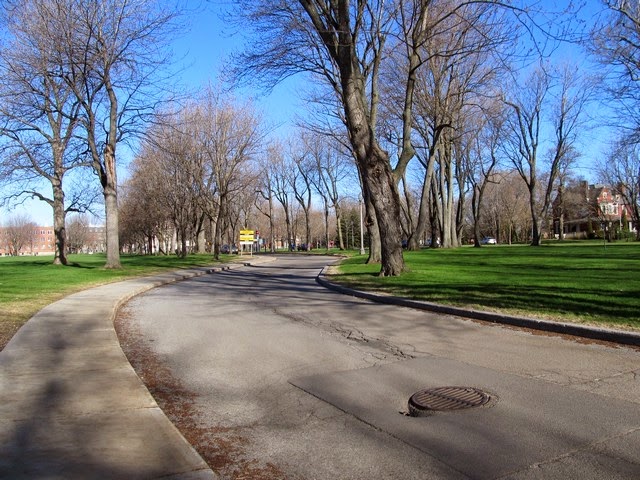


*crickets*
In reality, I've been going to the Douglas because I've started rTMS treatment. I can see the confusion, because I still wake up at 5:00 AM, but really? Really??
Anyway, the Douglas is this amazing, massive hospital that only treats mental illness. It's a teaching facility, research grounds, and hospital all-in-one, dedicated to understanding and treating the various things that can go so devastatingly wrong in the human mind. Ever since I got really sick 12 years ago, in 2002, I've secretly hoped that one day I'd end up there. They have resources I've never come into contact with before. I kept hoping maybe, one day, I'd be referred there and maybe we could figure out what's wrong with me. While it's obvious that I've had 4 episodes of Major Depressive Disorder, and that I have had / have PTSD and unresolved trauma, as well as recurrent suicidality and parasuicidal acts, what is less evident is why I've lived with some level of clinically significant depression constantly for twelve years, excluding the one 'healthy' period in mid-to-late 2006 through early 2007. Is it dysthymia? Is it refractory depression? Is it something else? Does it matter?
I guess I just kept hoping that maybe if I was sent here somebody could help me, that I could have a life truly worth living. That one day I could wake up and want to live.
Technically, I'm not at the Douglas. I've been sent here for a clinical trial, and then I'll be back off to my regular psychiatrist. Ah well, one day at a time.
It's a bit of a commute to get to Verdun from the North Shore. I wake up at 5, take a train at 6:35, take the Metro from McGill to De L'Eglise, and then take the 58 bus. Some of you know I hate buses because I am terrified of getting lost on them. Surprisingly, I actually like the commute. I get to take my regular train, which tricks me into feeling like a normal, productive, worthwhile member of society. I get to take the metro, and I like riding the metro. Then I take the bus.
The bus is okay.
Luckily, I don't miss my stop because there is a really helpful giant sign telling me that I am upon the Douglas. Like a YOU ARE HERE sign for my soul.
I like the sign. I find it comforting. I also find it relieving to get off the bus, because that means I will no longer get lost. But wait! The hospital grounds are huge! Still not likely to get lost though. :)
The first time I came to the Douglas I was lucky enough to have a good friend come with me. She had an app that told us when to get off the bus, plus if she hadn't been there I would have given up at the size of the driveway. The driveway is really, really, reeeeeeally long. I would have sat down in the snow and cried, unable to carry on any further. As it is, the driveway is getting easier. It also seems shorter because it's not covered in snow.
I also noticed, for the first time today, that the driveway is not actually straight. I was thinking it was straight as a pin, but in reality it has an s-curve. It's amazing what you notice when you look up instead of staring resolutely at the ground.
Coming here makes me feel a bit...serious. I mean, I knew that it was serious. It isn't like I could ever successfully ignore it. I like to minimize, to joke, to make light of things, to turn things around, to re-frame, to positivize. I don't like to face it. But I know. I know I'm really sick. It's just that it's more undeniable at some moments than at others. Weightier.
I knew I was very sick in 2002 when I found myself standing on the roof of the Arts building at McGill, looking down at the cold ground, wondering why I couldn't just bring myself to step off. My life falling apart, failing all my courses because I just couldn't do the work, the unbelievable pain, the whole world in grey-scale.
I knew I was very sick when my local hospital transferred me to St. Jerome, where I was committed, and where I wondered if I could hang myself with the curtain around my bed. I knew I was very sick when I started spending every night in the isolation room, tied down in four-point restraints. I knew I was very sick when I tried to crush my own windpipe with the side-rail of the hospital bed, and I was transferred to the Intensive Psychiatric Care Unit. I knew I was very sick when they released me into the care of a university psychiatrist, when he had me come and see him twice a week, when I tried to jump out his window during a session. I knew I was very sick when I sat on the floor in school bathrooms and scratched my wrists with razor blades.
I knew I was very sick in 2003 when I stockpiled small amounts of my daily-dispensed medication to make a cocktail with over-the-counter drugs and alcohol, when I had my stomach pumped and woke up in a freezing cold ICU to a doctor telling me it was a 'potentially fatal combination,' and to my own feeling of utter disappointment and despair. The feeling as I lay my head on the cold marble floor, losing consciousness, and thought, what if this is it? When I answered myself, I hope it will be over soon, and that this nothingness goes on forever, like the horizon.
I knew I was very sick as I battled extreme emotional instability throughout the rest of my first undergraduate degree. Always certain that today would be the day when everything was too much, that I couldn't go on, but that I owed it to so many people to keep struggling, to keep going on, because everything I knew about depression told me that if I just did what the doctor told me, went to therapy, worked on myself, one day I would get better. I knew I was sick when I believed that my teachers were involved in complex plots to kill me by informing my rapist where I was and what I was doing.
I knew I was very sick in 2005-2006, when I sliced into my skin every night with an Xacto knife, every incision deep enough to require stitches, but never going to the hospital, letting the scars accumulate. I knew I was very sick when I found myself thinking, as I dragged the blade through my flesh, that if I didn't do this the army wouldn't come and save me. I knew I was very sick when I swallowed just over a month's supply of sleeping pills. I knew I was sick when I woke up in emergency and, semi-conscious, tried to pull the IV out of my arm because I thought I could stab myself with it.
I knew I was very sick in 2009 when I was on the maximum dose of Wellbutrin (bupropion), with 4 other medications to try and augment it, and it was failing. I knew I was very sick when I requested, and took, 8 months of sick-leave from graduate school in 2010. I knew I was very sick when I had to go back to school and I wasn't better. I wasn't better enough to finish my degree, and I had to withdraw because I couldn't complete my program within the time limitations. I knew I was sick when I failed at the last thing that promised me I could have meaningful, rewarding work in my life that fit within the constraints of my illness.
I knew I was very sick in September 2013, when something felt fundamentally wrong, and my doctor didn't listen to me. I knew I was very sick as I went into a downward spiral, when my psychiatrist finally agreed to try medication, when my cocktail didn't work, as I became more and more unwell. When coworkers and friends commented on it. When my boss told me to take a vacation, or a sick day, or do something, anything. I knew I was sick while I was having a very public breakdown all over social media. I knew I was very sick because I knew that if I took even one foot off the path I would fall off completely, and there would be no coming back.
I knew I was very sick when I told my psychiatrist I was so tired, and he said I'd been tired for years. I wondered when that had become acceptable. I knew I was sick when I couldn't stop thinking about slicing my wrist open, about all the blood, about what my artery might look like right before I bled out. I knew I was sick when I started practicing on my thigh, and my doctor told me that I didn't want to kill myself, that we'd get me through this. I wondered when enough would finally really be enough.
I knew I was very sick when I went into St. Mary's in January 2014 to get 15 stitches in my wrist. I knew I was sick when they were telling me I was stable enough to leave. I knew I was sick when I left the hospital one evening and swallowed a bottle of Advil and wandered around outside in February, without a coat, for hours. I knew I was sick when the police picked me up after the hospital called it in, and brought me back with a firm grip on my arm. I knew I was sick when I was returned to the hospital and strangled myself with my own belt. When my new psychiatrist told me we were going to try this again.
I knew I was sick when my case was presented on general rounds, and all they managed to come up with was that I needed to learn how to 'bother people' when something is wrong. I feel like I've been bothering people for years.
I know I'm very sick because this illness has decimated my life, destroyed capacities and opportunities that I once took for granted, and devastated my sense of self-worth, of hopefulness, of trust in a future worth hanging on for.
I knew I was very sick when my new psychiatrist and I filled out the rTMS referral and had to list all the medications I've taken over the years. I knew I was very sick. But I felt like if I could hide it, if I could hold down a job for longer than 6 months, if I could volunteer, if I could get up and go about my day and muscle through it, that it didn't matter so very much that I was very sick.
But there's something about the Douglas that makes being very sick impossible to ignore. Maybe it's the bigness of it all, the sense that now I'm at the place where the experts go when they can't solve something. Maybe it's the impressive size and spread of the facilities.
You have to admit, it's really flippin' impressive.
Once I make it up (or is it down?) the driveway, I go around to the left of the front buildings and walk down to the building where my treatment lives. Presumably, when we're not there the treatment is having wild parties with the fMRI and PET scanners. At least that's what I like to imagine.
My building is super pretty. I'd never actually looked at it until today when I decided to take this picture. I love the design, the glass, the red brick. I'm happy I looked at it, glittering in all that sun.
Finally, I go inside the building and sit in this waiting area on the red chairs, where I usually try to read. I cuddle Puffy -- my stuffed animal -- and I wait. I like the quality of the light: it's very soothing. Mine is the first appointment of the day. I like the silence, the solitude, the softly falling light.
So, this is where I go everyday, and a little bit of the reason why I go here.
These are the first pictures I've taken since August. I even re-sized them and adjusted the colour levels. I hope you like them! :)
Subscribe to:
Posts (Atom)